
Hyperbaric Oxygen Therapy for Compromised Skin Grafts & Flaps
When surgical flaps or skin grafts show signs of vascular insufficiency or ischemia, hyperbaric oxygen supersaturates tissue beds, prevents necrosis, and salvages complex surgical reconstructions.
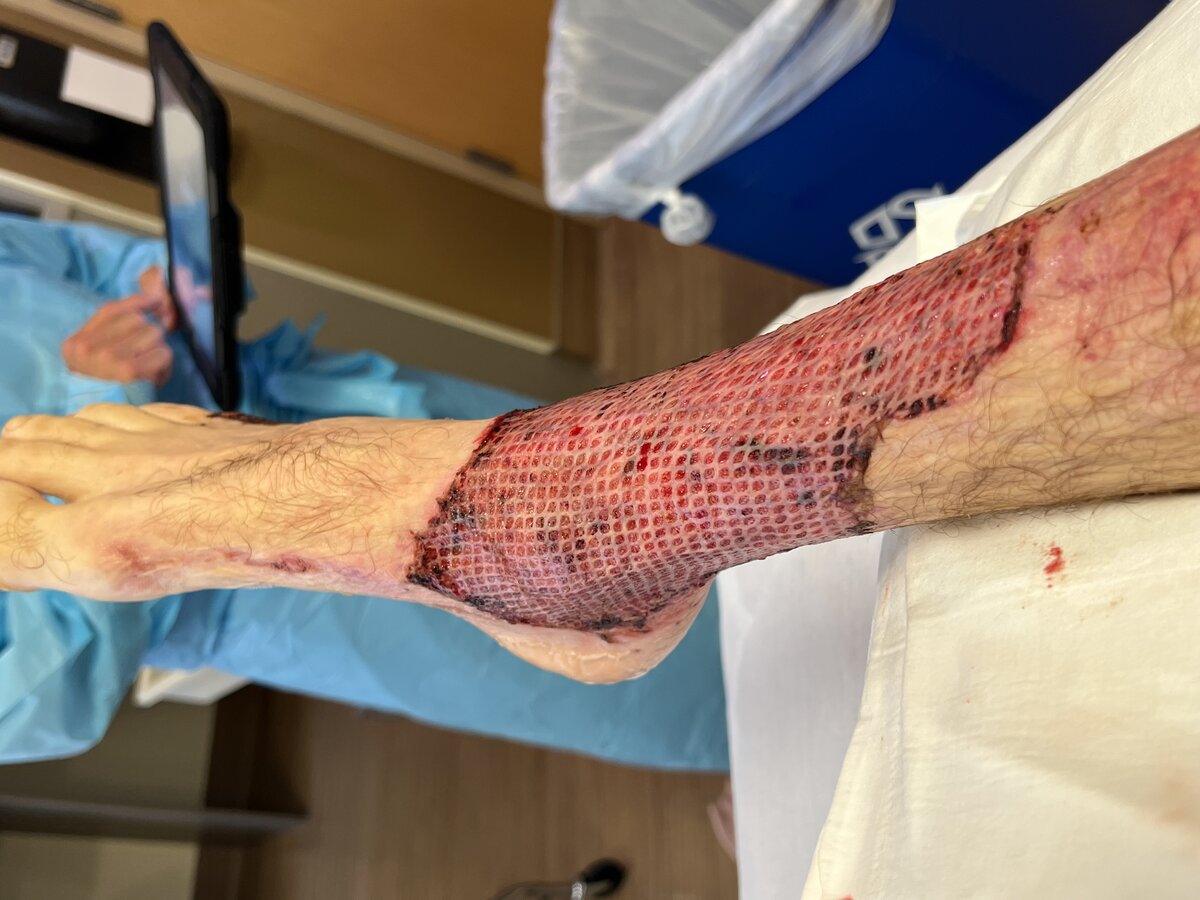
Signs of Threatened Graft or Flap Viability
Postoperative monitoring often reveals early indicators of arterial insufficiency, venous congestion, or marginal hypoxia. Immediate intervention halts progression to irreversible necrosis.
Marginal Cyanosis or Dusky Appearance
Skin edges or distal flap territories turning bluish-purple, dusky, or pale mottled white rather than healthy pink.
Sluggish or Absent Capillary Refill
Blanching tests taking longer than 3–4 seconds to return color, indicating severely impaired microvascular perfusion.
Venous Congestion & Tissue Turgor
Swollen, tense, or engorged tissue where venous outflow is restricted, causing blood pooling and cellular hypoxia.
Threatened Surgical Margins
Partial loss of skin adherence, blister formation, or marginal skin sloughing following reconstructive surgery.
The Science of Tissue Salvage
Hyperbaric oxygen provides a biological bridge, delivering life-saving oxygen to cells during the critical window before new microcirculation matures.
Sustaining Tissue Viability During the Critical Bridge
Skin grafts and flaps rely on establishing new capillary connections with the underlying host bed. HBOT supersaturates plasma with dissolved oxygen, diffusing oxygen directly into borderline ischemic cells even before new blood vessels have finished connecting.
Mitigating Ischemia-Reperfusion Damage
When blood flow is restored to ischemic tissue, it often triggers inflammatory damage and microvascular thrombosis. Hyperbaric oxygen downregulates endothelial adhesion molecules (ICAM-1), preventing white blood cells from clogging delicate capillaries.
Accelerating Rapid Capillary Sprouting (Angiogenesis)
Oxygen acts as a molecular signaling agent, stimulating massive upregulation of Vascular Endothelial Growth Factor (VEGF) and fibroblast growth factors, dramatically accelerating microvascular bud formation into the graft.
Relieving Microvascular Edema & Swelling
Hyperoxia induces mild vasoconstriction that decreases fluid filtration and tissue edema without compromising tissue oxygenation, improving the pressure gradient for venous drainage.
Seamless Coordination with Reconstructive Surgeons
We collaborate directly with plastic surgeons, ENT head & neck surgeons, orthopedic reconstructive teams, and general surgeons. We provide photographic wound documentation after every session, maintain open communication with the operative team, and adapt pressure regimens in real time.
Graft & Flap Salvage Questions & Answers
How quickly should a compromised flap or graft receive hyperbaric therapy?
As quickly as possible! While completely necrotic tissue cannot be revived, compromised or ischemic tissue that is still viable can be salvaged if therapy begins promptly. We urge reconstructive plastic surgeons, ENT head & neck surgeons, and surgical teams to contact our clinic immediately at (705) 302-6540 for expedited same-day intake.
Is hyperbaric therapy for compromised grafts covered by OHIP?
Yes, 100%. Under Ontario Ministry of Health (OHIP) and Undersea and Hyperbaric Medical Society (UHMS) clinical criteria, hyperbaric oxygen therapy is fully covered for compromised skin grafts and flaps. There are zero out-of-pocket costs for the patient.
What is the treatment schedule for an acute flap salvage?
For urgent surgical flap or graft compromise, patients often receive treatments at 2.0 to 2.4 ATA for 90 minutes twice daily for the first 48 to 72 hours to stabilize tissue viability. Once the graft has visibly pinked up and capillary refill has normalized, treatments typically transition to once daily for an additional 10 to 14 days.
Can hyperbaric therapy be used preventatively before surgery?
Yes! In previously irradiated tissue beds (such as head and neck reconstructions or post-radiation breast reconstruction), hyperbaric oxygen therapy is frequently used pre-operatively (typically 20 sessions) and post-operatively (10 sessions) to stimulate angiogenesis in the scarred recipient bed, dramatically improving initial graft take rates.
How do referring surgeons communicate with the Simcoe Hyperbarics team?
Surgeons or clinic nurses can submit an online referral, fax surgical notes to (705) 881-1119, or call Dr. Rishi Parihar and our on-site team directly at (705) 302-6540. We provide same-day clinical assessment and immediate photo updates after each dive.
Every Hour Counts in Flap Salvage
Protect the surgical result and prevent tissue loss. Contact Simcoe Hyperbarics immediately for expedited patient admission.